Google

Wednesday, November 13, 2019

On the subject of Del Rio

After 25 years away, this spring I finally returned to the place where I spent most of the first four years of my adulthood.   Before we left, I knew I had difficulty visualizing the town, the area.  So on one level, I had a hard time remembering how things looked, but I figured I'd return and look around and it would all come flooding back.  But no.  Not at all.
I drove around town, and I recognized the names of Don Marcelino's restaurant, and Wal Mart, the Sirloin Stockade, Wright’s Steakhouse…  but ... that was it.  I knew the main street names were Avenue F and G, and there they were.  But I could never tell you where I was at when the guy ran into my rear bumper.  Absolutely nothing looked even remotely familiar.  I remember the guy we’d see occasionally at a stop light, with an old hound dog standing on the roof of his truck, but I didn’t see them now, and I’m not even sure where that stop light was.
On some level, I have been really dismayed by this blindness into my own history.  I have very fond memories of some of my time there.  That is to say, I really enjoyed the job, but more than that, the people I worked with.  While living there, I remember going west as far as Langtry, Texas to the Judge Roy Bean saloon.  Going north to Sonora Caverns, and of course, trips to San Antonio.  I remember those areas, at least a little.  I remember the feel if not the detail of the River Walk in San Antonio, but the road to and through Del Rio itself?  Nothing.  It seems like a blank slate. 
In 2019, I found myself amazed all over again by how devoid of trees and how flat Del Rio is.  On some level, I knew it was that way.  That treeless expanse has always been my 'first impression' remembrance of the area, but the reality now vs. my memory is like seeing the Grand Canyon in person after only ever seeing it on a post card.  I drove past the home of someone whom I used to work with, where I have fond memories of being welcomed as a part of their family for a holiday gathering... and I did not recognized the house or street at all. 
I have pondered on that blank place in my memory over the past few months.
It dawns on me that if I go back to my earliest childhood, I would read the books on the bookshelf in the hallway when we lived in the old homeplace.  There was a battered copy of Swiss Family Robinson and Robinson Crusoe, there were the Hardy Boys and Nancy Drew books, and there were others.  And I would read them, forget the contents and read them again.  I may not have been completely surprised at the climax but I was pretty good at suppressing the details so as to make the stories new again.
That self-training kept me entertained on long summer days and nights, and has allowed me to watch and re-watch movies over the years, without really remembering the details - just the impressions of big ideas or themes.  It causes me to be unable to remember quotes or even lyrics, exactly as they are uttered, because I remember the impression or feeling it left behind more so than the words.  It makes me want to avoid Robin William's "What Dreams May Come" even though I recall it is in places visually stunning, because I feel the death involved in the storyline, even though I can't recall the details.
Back to Del Rio, Texas. It is a small town nestled along the banks of the Rio Grande River, just across from Cuidad Acuna, Mexico.  My earliest knowledge of Del Rio comes from a childhood where I read everything I came into contact with - and back then almost all coupons had an address of 1 Fawcett Drive, Del Rio Texas or something similar.  To this day, many manufacturer or retail coupons are still processed there.  So I at least knew it existed.  After being stationed there, folks would say, "Oh, I remember Del Rio... We used to listen to the radio station..." At some point in time before I was there Del Rio had a super-powerful signal and broadcast across much of the western USA.  The area near Laughlin and Del Rio was home to filming of several movies over the years, including Lonesome Dove and John Wayne’s The Alamo, which were filmed at the Alamo Village outside of Bracketville just down the road.
But that evening in late September 1990 that I arrived, it was well after dark, and my aunt and uncle dropped me and ran.  I was given a key to a strange room in the base’s hotel (the Temporary Lodging Facility or TLF).  When I opened the door, a woman cried out… I closed the door and went back for a different key to a different room.  Waking up the next morning, my first morning there, I was a 19 year old Arkansas farm boy named James, who, having grown up surrounded by farms, and woods, and hills, went outside to see ... nothingness.   There was something, all right.  But not trees.  Not hills.  Just wide open country covered with scrubby bushes.  So the first jolt to me was this feeling of surreal surroundings - I may as well have been on the surface of Mars.  I was disoriented.  Out of place.
Then I had to get in touch with my sponsor.  Thus far, in my 6-month Air Force career, all the Non Commissioned Officers that I had been around were instructors of some sort - drill sergeants, teachers.  They were all 'up there' and beyond me.  My sponsor, the one whose job it would be to show me around and get me acquainted with life there, was appointed by the Air Force. His name was Sgt Gomez, and being in Del Rio, obviously he was of Mexican descent, was an eight foot tall drill sergeant of a character, and would yell a lot.  But actually, as I recall, he showed up to pick me up, riding with SSgt Trusty in his Dodge K-Car, and they took me out to eat in town at a Chinese restaurant.  This eight foot guy turned into someone who was slim, soft-spoken, probably 5'6" or thereabouts, and super-nice.  While we were ordering food, I was yes-sirring and no-sirring, but it did not take them long at all to tell me to cut it out.  "We work for a living!!" they said.  This Chinese food experience was my first...  Following the firsts over the past 6 months of 1) having a physical, 2) riding in a taxi 3) riding in an airplane (a handful of times) 4) riding on a city bus (town pass in basic training) 5) riding on a Greyhound (going to tech school) 6) seeing the ocean and 7) walking on a sandy beach (in Biloxi) 8) sleeping and bathing with 40 other guys who were all different from me but who all had shaved heads, wore brown t-shirts and wore BDUs or white-t-shirts and blues 9) running and exercising and doing the confidence course and feeding punch cards through a computer and shooting an M16 and............. all that stuff.
Now, here I was, all alone, but for these two guys who had so little in common with me but who were willing to be patient while I adjusted to uniformed life.  At work, I was introduced to the shift supervisors, who were civil servants named Rob, Pete, and Maria.  Rob was a retired Tech Sergeant and Pete a retired Master Sergeant, and I’m not sure about Maria... I never worked directly with Maria, but she was a nice lady.  Down the hall was Edith Morgan, now Smith, who was the database manager.  Chief Henson was from Alabama, and nominally ran the office, but Edith was really the one who knew and orchestrated the important stuff.  TSgts Boykin and Prys were there then as I recall.
I was assigned to work with Rob, who became something of a foster-father to me.  He was a bit rough around the edges, but had a heart of gold.  The first time on mid shift a couple weeks after I started, he sent me into the break room to make coffee.  The Bunn coffee maker there was 8 or 10 cups, the can of Folgers Coffee said a scoop per cup or something similar, so I started scooping it in.  When it was done, you could stand a spoon up in it.  To give me credit, I did drink most of a cup before we poured it out and started over again. 
The folks at the Squadron and in the office kept asking me in those first days, “Your name is James, but what do they call you… James, Jim, Jimmy?” and I’d just answer, “Any of the above work… I’ve likely been called worse!”  I soon became Jimmy, because the organization already had an overabundance of James’s and Jim’s, and it was fine by me.
In the four years living at Laughlin, I lived as Jimmy Wheeler, kid from Arkansas.  I made some great friends, and went home every chance I could to see my family, and plant some trees.  When I left four years later, I left all that behind.  I kept in touch with a small number of people, and in Alabama, I was once again surrounded by hills and trees and people that called me James.
After almost four years, I had stepped out of the character Jimmy on the set of the Alamo, and became James, once more surrounded by normalcy, and got busy with work.  Looking back, it really seems almost that simple.  I forgot the story, the quotable moments, except for what I brought with me.  I kept in touch with a few friends over the years but lost touch with many more.
I suffer now from a sense of loss, but it’s not heartbreaking.  More introspective.  I talked to Rob off and on over the next few years – even went to dinner with him and drove caravan with him once when he went to Alabama for training.  I missed his wedding and his funeral, and for that I am truly regretful.  I don’t need to get into the dark places where I lived when he was at his end.
Jose, who at Laughlin was a staff sergeant who went on to Office Training School and became Lieutenant Acosta, came driving onto my base in Alabama, where we randomly crossed paths, and there we became friends while being stationed together again for a while.  I’ve spent nights at the Wallings’ home while traveling across country, and we briefly lived with my friend Gwen in Oklahoma before moving to Pennsylvania.  I chat with or interact with Mike and Tess and even Abe once in a while on Facebook… So some connections from Del Rio remain, no matter how tenuous.
I am thankful to have rediscovered Pete, and have had (online) conversations with him in recent weeks.  I remember going to his home for a holiday gathering at some point and being made to feel very welcome, not a guest at the table, but a part of the family. 
The Alamo in San Antonio
In San Antonio, this spring, we had a great conversation with a local AT&T (not wireless) employee who was at our AirBnB to fix the internet connection.  He was a soft spoken Hispanic gentleman, telling us about sights to see, about float trips down rivers in south Texas and taking the time to relax and enjoy life.  He WAS Texas, just as I remember it.  An ordinary nice person relating his experience and being hospitable.  Going out west in June, we could sit on the porch in front of or inside the dining room of the Starlight Theatre in Terlingua or the White Buffalo in Marathon, and listen to tales being told, and feel at home.
Julios Chips in Del Rio
I am thankful to have the opportunity now to see some things for the first time (again).  To see things that I could not see at 19.  I am thankful to go sleep under the Milky Way and see its bright beauty, but to also see the mesquite and desert willow and agave in bloom.  To see torrential downpours that flooded side roads from the highway I was on, showing me more water in a day than I remember seeing in almost four years before.  To see the wide open spaces and grow past the otherness and embrace the diversity.
Starlight Theatre in Terlingua
But the scant couple of hours I spent in town, that day in June, from the stop at Julios for their world-famous chips to the pit stop at Wal Mart for supplies, and the driving around town between… I am still not sure how I feel about having such a blank spot inside of my psyche.  It was a long time now (but not that long…) since I played the role of Jimmy in my own “Alamo” or was it maybe “Jimmy’s Lonesome Dove.”  The figurative movie set where I lived, breathed, and worked for almost four years was abandoned by the star but not dismantled and it was disorienting to step back into it and see that others continued the story without my presence.  Much like the child-me that forgot about Robinson Crusoe and Frank and Joe Hardy so I could reread with excitement the next time, and again. I am ready to pick up the book and read it again. To watch the movie and know that the book that I read before can be different and it’s okay.
The me of today wants to go exploring there, to SEE what the blind kid that once lived there could not.  To cross back into Acuna and see if there is still good food and nice shopkeepers and beggars trying to get me to take their Chiclets Gum packets (I’ve read that Chiclets is no more… what do they do now??).  I remember so much but so little at the same time.

Thanks for letting me wander down memory lane.  This is not a post with an ending… Just … sharing my momentary disorientation.


Saturday, March 09, 2019

Thoughts on cameras

My journey.

In high school, I was a yearbook photographer in my junior year.  They had a 35mm Canon AE-1 that did all right... We did not have a darkroom so the local drug store processed the film.  Over the years, I have always had a camera, but often would pile up 18 rolls of film over a couple years' time before I'd get it developed.

My first foray into digital cameras was a used Fuji Finepix that a neighbor gifted to me after her husband passed away and I helped keep her yard cut and stuff till she settled the estate.  This was around 2004.  It was a 2 megapixel, with few 'quality' settings.  I very quickly outgrew it because it was limiting - but it really opened my eyes to the possibilities of digital.

I do have one shot taken with it that I still really like.


Without resizing software, you'd be hard pressed to get much beyond an 8x10 with this photo because it would just get too pixelated.  I actually took the photo after buying a new camera and running down the battery.  I left the battery on the charger and we left to go somewhere, and I had one of those 'whoa!' moments, where I turned and went back.  This camera was what I had so I used it.

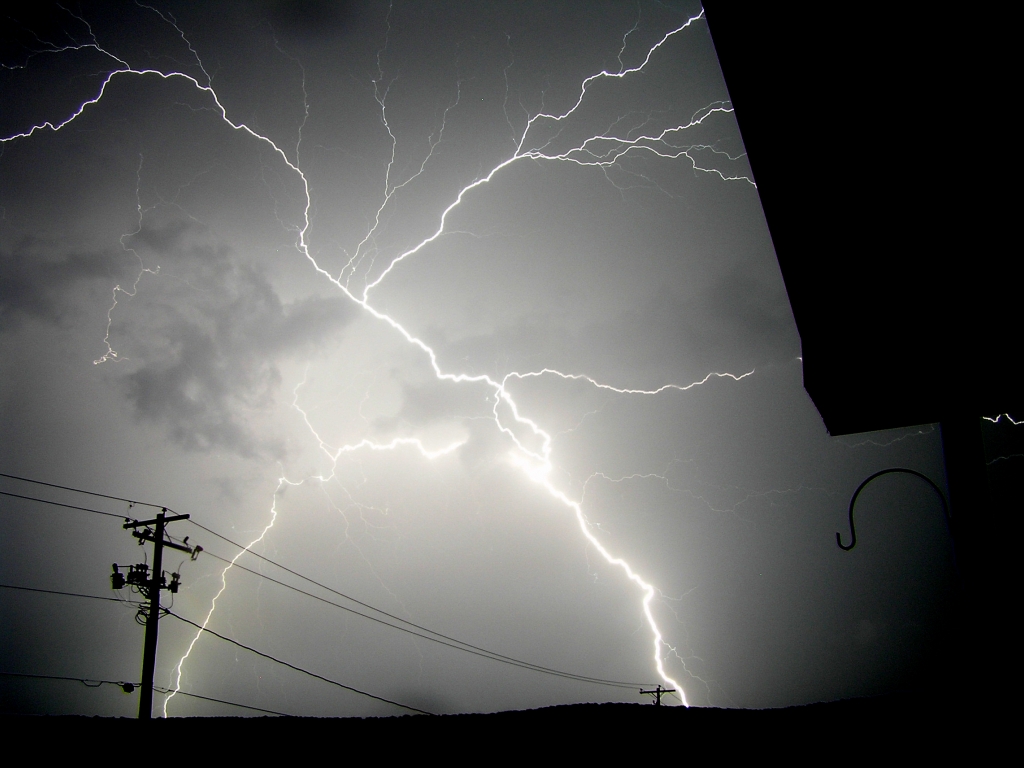
The replacement camera was an Olympus camera with a 10x zoom - just a small point and zoom.  At the time, 10x optical zoom was really something - nowadays it's nothing.  This camera was 4.1 MP, and I took many thousands of photos with it.  I got down on the ground and took pics of the forest floor (lichens are cool!!!).  I took pictures of moving water.  One night I took 60 pictures (no lie) of a black sky as a thunderstorm marched up the valley to the back of my house.  Disgusted, I went inside and quit.  Except I started playing with settings and figured out I could do a '15 second' exposure in one of the more advanced modes.  So I went out on the front porch, where the storm was at by now, and the third shot, I got this.


So this camera had strengths and weaknesses.  It was compact, and easy to use.  It took great outdoor shots.  The battery could deliver hundreds of shots before needing to be recharged.  It could do macros as close as 1CM.  It sucked in low light.  Despite being only 4.1MP, I could do photo prints up to 12x18.

After having had this one for awhile, I 'upgraded' to a Sony point-and-shoot, with something like maybe a 16x or 20x zoom - can't remember now.  It was 8MP.  How I hated that camera!!!!!  This was before Sony bought out Minolta and started marketing SLR's... The camera had a great zoom.  But it had absolutely no quality settings.  No RAW or TIFF mode, no super-fine jpg or anything.  It just took pictures.  And on a perfect day, they were okay.  I'd have been hard pressed to do prints much larger than an 8x10 despite having twice the megapixels of the Olympus.

I started thinking about SLR cameras... I needed to do something.  I was up to about 2008, and the older camera was barely functional (it took a beating including a day when I slipped on the ice and the camera went one direction and me another).  The Sony sucked.  I decided to ebay a used film Canon.  After a month, I was hooked... So I bought a Canon XSI (12.2MP), entry-level but decent camera.  Actually I ordered 2 because it went on sale a couple days later.  I had a 21 day return window, and about day 20 contacted Dell to get a return authorization on the original camera, and turns out the clock started the day I submitted the order, not the day I received it, so despite delays, they would NOT let me ship either camera back.  So I've had 2 identical cameras for years.  I later bought another Olympus, and have used it now and again... But I have not upgraded a camera in 10 years+, although I bought Robin a Panasonic in 2013 for Christmas (more on that in a bit).

I am way past due for something new.  The question is, what?

Impressions from the past experiences.

SLR cameras.

Canon and Nikon are hard to beat.  They both have overall great reputations, are dependable, and everyone uses them.  I had a friend who was into Canon so I figured why not.  I'd probably do Nikon if I were starting over, but really either is okay.  Pentax is interesting.  They have been around a long time.  You get more bang for your buck.  The cameras are sturdier with more weather sealing, but the image quality overall is a bit lower.  It's all relative.

The Canon SLR cannot be beat for image quality overall, and for reliability although both cameras have lately started to act up.  I am well past their rated cycles on shutter life, because I was a glutton on camera usage for a long time.  I have the basic 18-55mm type lens, and a Sigma 70-300mm lens, a Canon 50mm F1.8 lens, and a Tamron F2.8 90mm lens.

If I bring all the lenses along, I have to use my huge bag.  And none of them are spectacular, although all have strengths.  The one I'd replace if I keep the canon line is the 70-300mm - Canon makes better and they are cheaper/lighter now.  The Tamron takes wonderful macros but you have to be a foot or two away from the subject.

This camera model did 'live view' which was new in SLR cameras at the time but is a standard now - and had been for a long time in point and shoots.  It doesn't have a movable screen (articulating screen) so you either used the viewfinder or stared at the back.  I'd probably rather not have one that doesn't have a flip out screen anymore.  It didn't do video, which is another standard feature now.

So yeah... Unless someone gives me a bunch of Nikon lenses, sooner or later I'll get a newer model Canon SLR.  Maybe even something like this with the extra lens:  https://shop.usa.canon.com/shop/en/catalog/eos-rebel-t7i-video-creator-kit


Other Cameras.

If I had $1000 to throw away today I'd hold off on an SLR, and buy this:

It's not an every day camera.  It's bulkier by far than my SLR.  But on a tripod, I could take clear pictures of the craters on the moon and fuzzy pictures of Saturn's rings.

I think the technology will get better and cheaper and in a few years this might be a low-end camera by then.  So I don't know that I can justify $1000 on the thing.  But boy, I want me some of those moon shots.

Back to more realistic options.

Robin's Panasonic.  It was on a Black Friday sale for $349 as I recall.  It was the Lumix FZ300.  I bought it for one reason.  It could do low light and well.  The zoom for its entire range (something like 24x) could do F2.8 (which means it lets a lot of light in, so does low light well).  It does a pretty good job of outdoor photography.  Maybe the prints aren't as perfect as a good Canon SLR, but it can certainly do action and low light and people and places and do a good job of them all.  At the time, I was thinking 'School Concerts' because all my cameras were very hit or miss as to whether you could actually get focused on a kid's face or not.  She has since continued to use it for product photography shots (see wheeloflightstudio.com for her solidarity cups).

The current model is the FZ300 and it's been out a few years.  Still has that low light capability that made the original camera such a  great option.  It's only 12.1 MP; and for this price point should be upgraded.  https://shop.panasonic.com/cameras-and-camcorders/cameras/lumix-point-and-shoot-cameras/DMC-FZ300K.html

But all-in-all, a great option for anyone as long as you don't want to do poster-sized prints.

My criteria at the moment is... maybe....

Something 20mp or more simply because less seems archaic these days.
Probably a point-and-shoot and not an SLR simply because I get frustrated with the switching attachments all the time.
Something that can do macro shots at 1CM from the lens (I really like getting close the the flower/bug/whatever).

Something that can zoom quite a ways.
Something with an articulating screen so I can see myself if the camera is on a tripod, or so that I don't have to lay on my belly to get that four leaf clover in focus.

This all points me to a category of camera sometimes referred to as a 'bridge' camera (now they're changing that a little and calling them long-zoom cameras).  A good up-to-date round up of cameras in this class is here (browse around a bit - a great resource for camera hunters).

https://www.dpreview.com/reviews/buying-guide-best-enthusiast-long-zoom-cameras

There are a number of other buying guides here as well as reviews that show sample photos and comparable models.

There are large-sensor models and small sensor models.  There are smaller versions of SLR that aren't SLR at all but similarly work with lenses (referred sometimes as simply ILC cameras - interchangeable lenses).

Friday, April 05, 2013

Gardening for the Soul

If you ask the simple question, "What does it take to make things grow?", you get a multitude of answers. Think in terms of a garden... You need sunlight. True. You need water. True. You need dirt. True, yet again. All of those things are unquestionably essential. But can you grow things with nothing but dirt, water, and sun? Sure you can.

But to grow things well, you might want to till the dirt before you get started. Dig it up deeply. Stir things up. You might even want to mix in some undesireables. They're available whether you want them or not, so instead of excluding them, welcome them in. Mushroom soil, or just plain old manure, or even something as simple as dead fish. All those stinky things that we'd rather suppress or put away from our minds (and noses)... Because without that malodorous fertilizer to encourage growth it will likely not be quite as productive.

Then you're going to need some good seeds. I mean, there's nothing wrong with letting the birds plant your garden for you, but it takes some effort on your part to choose those things YOU desire to grow. We all love the poison ivy that shows up uninvited, but it's not quite as nice as the petunias you had hoped for. And it surely cannot take the place of an ear of corn on your dinner plate.

So we take a little forethought, we till the ground until the soil is loose and ready to plant, then till a bit more to mix in all the stinky stuff, create our furrows, plant our seeds.

Then we go off and take a long summer's nap and await the crop? No?

My frustration has been, prepare as I might, once the garden is growing, it's all too easy to get busy and forget to tend it. But at some point, when the green shoots start to push through this fertile ground, not all of them are friendly. There are the wild seeds planted by birds, the grass whose roots managed to survive the tiller. Everything wants to jump into your little patch of heaven. If you pay attention to the garden, you will see the need to tend your crop, whether that is to hoe a few weeds or to put a bit of mulch down around the keepers so as to encourage their growth while slowing down the other, it takes a bit of constant nurturing but sooner or later you will end up with a thriving garden.

Imagine, if you will, midsummer arriving, with its varying downpours and long days of harsh sunlight, the garden growing at a rapid pace, then withering a bit in the heat of the day. If you have done your job well, there will be enough cover to hold in moisture so that the crop can continue to grow, little competition of distracting weeds. But what would happen if you decided that the smell of the manure is too strong? Would you get a shop vac, and enter the garden, to remove that unpleasantness? Will you go in with shovels to do the same?

Of course not! It would be not only utterly silly, it would be disastrous. Without the rich soil to support the roots of your plants, they would wither and die.

With proper care you will have a wonderful crop.

Imagine our lives, our souls, as a huge, living, breathing ecosystem. A garden inside our bodies. With careful tending, the crops we grow will thrive, through storm and drought. Through long sunny days and dark, dark nights.

But it seems that as humans, we cannot accept the imperfect inside of ourselves. We must destroy it, suppress it, throw it out. The dead fish and the manure must go.  And our lives are diminished because of it.

What if, instead, we were to accept that these unpleasant things are just byproducts of a natural process, and incorporate them in some healthy way? Why not accept them and not dwell on the negativity, and find ways to enrich ourselves through that acceptance?

We can grow a garden, of sorts, with only sunlight, water, and dirt. But wouldn't our garden be better if we put some forethought and care into it? Carefully till and fertilize, select only the best seeds to plant in just the right places, and lovingly nurture them. As weeds sprout, we find them, and acknowledge them, and return them to the compost bin to be recycled with the new crop of fertilizer, for future crops, allowing the good plants space to grow and thrive.

Saturday, February 23, 2013

Fear and its nemesis


It is natural for all of us to experience fear.

There are many fearful situations that either exist or potentially could exist in our world, in our daily routines.

So how do we get beyond our crippling fear?

Do we deny it?  Bury it?  Run from it?

They say, "There is nothing to fear except fear itself..."  But who are they, and what do they know about me and my situation?  In all of the millions upon millions of people in the world, I am unique in my soul, and my experiences, and in my perceptions.  THEY don't know anything.

So how can one deal with one's fears, one's insecurities?

How, indeed?

I think willpower alone is not the answer.  Many of us just muscle through the days fighting against the demons that haunt us, reaching the end of our day, spent, trembling with exhaustion.  Do you?

I believe there is a journey involved, and it's not likely to be something we are transformed by overnight.

I found myself, a few years ago, relating a story of myself to someone I barely knew, and at the end of it came to the question, the core question, "Am I even a good person?"

In my own mind, I thought I knew I was better than Hitler, but beyond that...  What was really down there?  Objectively, I could see that I made better decisions day-to-day than some people, but I made bad decisions and lived bad examples, as well.  Which left me adrift in a wide sea where I didn't quite have an anchor.  So at the end of my story, the core question was presented.

"Am I a good person?"

The person with whom I was corresponding took some time to answer, and when she did, she related her own story.  It told of a young, somewhat naive and innocent person, who experienced some very tragic events in her life, and after weeks and months of despair and agony, she tried to end her own life.  At the last moment, she was moved to take action to save herself.  She ended up in an emergency room, and she survived.  She became a better person for having survived the original tragedy and the one averted... But for having done what might be considered the Ultimate Sin, she asked me, "Does this make me a bad person?"

My answer?  "Of course not.  You were a good person in a bad place."

That answer... It was my own answer.  It has stayed with me, for years.  Picture yourself, or anyone, in his or her darkest days.  Just because you live or lived there, does that make you a bad person?  Of course not.  You are a good person who has been in a bad place.

Our intuitive nature often leads us into trains of thought where we depict ourselves as moral failures, when quite often, we are beacons to someone, somewhere.  But doesn't that just make it worse?  We think that "if they only knew the half of it....." (somehow we think that they would think we're just shams, living our lives in some two-faced lie...).

But sometimes our self-intuition is wrong.  The truth of the matter is we are all human.  This human condition makes us imperfect.  That is true of every person living.

We are human?  Does this make us bad?  No, we are good people, sometimes finding ourselves in bad places.

So if we can wrap our souls around that idea, that it's okay to be a human being once in a while, and not a saint.  If we can accept the shadow, acknowledge it, deal with it, then we can begin to grow, to move on, with our journey.

Try this exercise   Go to a mirror, and look into it.  Don't look at the mirror.  Don't look at the hair on the person you see.  Don't look at the eyes, the nose, the shoulders.  Close your eyes for a moment, then look again into the mirror.  There's a stranger there, that looks just like you.  Take a few moments, and look into that person, through their eyes into something deeper.  Forget all the surface stuff you see, and try to find what is buried underneath it.  Don't be fearful.  When you can begin to discern the soul hidden underneath all the layers of outside-ness, tell it, "I love you."

Really.  If at first, you don't succeed, if you cannot find your voice, or if you cannot see the soul, then pray, meditate, live.  And each time you look at the mirror, take a moment or two to look deeper.  Try saying, "I love you."  Try feeling it.  Live it.  Find that Spark of Divinity, Spark of Beauty, that lives in every human being, the one spot of innocence and perfection that is down there, somewhere.

And if you cannot, then ask questions.  Why?  Why can I not go there?

I would not ask, "What is wrong with me?" but rather "Why can I not see?".

Because at the bottom of it all, the fault is not "me", the fault is blindness.  And our journey involves opening up the blinders.  Of seeking, and exploring, and accepting the good as well as the things we perceive as bad within ourselves.  Remember, always, that you are a human, and you are imperfect, but your imperfections are not bad, in and of themselves.  The actions you take based on your imperfections can have tragic consequences, for yourself or for others, so you must learn to cultivate the positive aspects of your soul and accept the darkness instead of letting it remain suppressed until it rages outward, with a life of its own.

A good example I heard recently, was this image of a person that knows sometimes when they have a bad mood, it creates a black cloud around them, and soon everyone in the home is snipping at each other.  But those days when they get up, that's just how it is... No one can escape it.  But what if that same person got up, and recognized the signs, and says, "Oh here we go again...."  And laughs at the grump, saying "I am going to go out and do the opposite of what old grump-head wants me to do, and goes into the day with a positive attitude."  The darkness is still there, but because it was consciously acknowledged, it is put in its place.  The downside is that maybe everyone else can still sense it, and expects this to be just another dark day, and their responses are automatic reactions to the past... The answer is to break out of it.  Tell a joke. Go to a quiet place, and read a book.  Watch something fun or inspirational on television.  Pray.  Old habits die hard, but they never die unless you consciously focus on them.

Bottom line is that we are all human.  But if we can take the time to look into the mirror, and accept and love the soul we see, then we can move forward through life, understanding that we are worthy of love, of respect.  When there are those "out there" that refuse to see the good that you know exists "in here" then the failing is theirs, not yours.  Repeat that.  "When others do not show love or respect, it is their failing, not mine."

Always strive to show kindness and compassion to others.  Just as you may have found or may find something divine within yourself, worthy of love, that spark exists within every human, as well.  So humanity is not just about the dark things we do, feel, live.  It is just as much about the light.  Just as the best people you know have flaws, so the worst have goodness.  It's hard to understand and believe this as well.  There have been monsters who lived on the Earth, responsible for the deaths of thousands or millions of people.  But even they, too, once were innocent souls, conceived in a womb.  When you run across someone that you perceive as less than worthy, instead of judging them, yelling at them, talking badly about them, just consider that they are human, too, and quite possibly not as enlightened as you.  If you can, pray for their situation, and if you cannot then accept the fact that their failings are not your fault.  And move on.

Once you can recognize that Spark of the Divine within yourself, look again at the world around you.  Stop to smell the roses.  Stop to look at a snowflake.  Stop to gaze up at the full moon or the starry skies or the bolt of lightning streaking across a dark sky.  There is that Divine Spark, that Beauty, all around us, and as long as we have removed the blinders, hopefully we can begin to see.

"I once was blind, but now I see..."  When you are comfortable within your own skin, and you can perceive that the world IS a beautiful place, and you are, too, then you can begin to live a life transformed.

I was recently called into a manager's office at work, someone who does not much like or appreciate me. I do not know his whole story, but I sense that perhaps he feels somehow threatened by me.  He says things, but then does other things, and suggests that I am not grateful for appreciating what little was done.  He doesn't listen to me, but instead responds to his perceptions of me.  I sit in the office, calm with the faithful knowledge that I am good, and however this meeting may go, it will be all right.  He reacts to my smiles when he tells half-truths, and I realize that my calm really annoys him.  Underneath my skin, I have a guilty pleasure in knowing that he is angry because I am not.  That, too, is my humanity shining through.  Worst case scenario, my meeting could lead to termination with my employer.  I don't think it will, but if it did, what then?

I'd go find another door to open and life will go on.  Bottom line, sometimes we need dark moments to force us into change, and change can be a very good thing.

After the meeting was over, looking back over the time, I realized that although I had been somewhat nervous going in, I was uplifted by the faith that I am a good person, and not trying to 'get one over on anyone', and it's all good.  And the fact that I didn't react visibly made the manager very upset.  But it is what it is.  "When others do not show love or respect, it is their failing, not mine."

I just turned forty-two years old.  That is twice twenty-one.  I think about that.  How many things have I done in the past 21 years?  How much have I grown?  Looking forward, how many more Good Things can I accomplish in the next 21?  The next 42?  In the big scheme of things, a meeting with my boss or any other uncomfortable situation that last a half hour or a week or a month, are not so important after all.

Learn to have Faith in your Goodness.  Learn to Respect Yourself.  Learn to Live with Life, and not against it.  Faith begins to come naturally.  And with Faith, comes the companion, Hope.  Armed with Faith and Hope, and Love, none of the day-to-day challenges that we all face will cause too much pain.  And THAT is what conquers fear.


I would argue that what we should strive for is to live a better life.  It's as simple as that.  If we are living a Good Life, then we can accept the challenges that come, holding the hands of our neighbor when they or we need strength.  Love without bounds.  And LIVE.

Thursday, November 29, 2012

February 20, 1986


February 20, 1986.

Now THAT seems like such a long time ago.  I was in 9th grade, and that was my 15th birthday.

The other day I found something.  It was a birthday card. Ruth and Glenn Hicks had given it to me, and it was printed on parchment paper, and purported to be a "Happy Life Insurance Policy" and it listed all the reasons why I should celebrate and be merry for this birthday and for many more to come.  It insists that despite all the negative things that might be out there, that I deserve to be happy, and that I have the right to pout if I am not.

Less than a month before my birthday the space shuttle Challenger exploded on takeoff, sending parts of itself down into the Atlantic with great plumes of smoke.  The repeated video footage of the event would imprint themselves on my brain, and to this day I can see the three main trails of debris as they fell toward the water.

On board was the first school teacher to attempt reaching into space, Christa McAuliffe.  I was sitting in English class, and Mr. Ramage, the principle, came to the door, calling out Mrs. Parker, to inform her.  We didn't know Christa, but it didn't matter…

Two and a half months before the Challenger tragedy, I went to school one day.  Dennis, my brother-in-law, came knocking on the door of my agri class, telling Mr. Watkins that he needed to speak to me.  I went out into the shop, where I was told, "James, I don't know how to tell you this, but your Dad is dead."  You know, it took a lot of courage to do that, to be so open and up front with me about what was going on.  I don't know how much he knew of what had happened, but as it turned out, Dad and Ted had gone to do some work that morning, and Dad told Ted that he wasn't feeling well, leaving the tractor and going up to the truck to sit down for a few minutes.  When he didn't return, Ted went looking and found him.

Tiny Goodman, the coroner, said that a team of the world's best doctors probably couldn't have saved him – he had a massive heart attack and his life was snuffed out just like that. I spent a long time regretting that I had not told him "I love you" that morning as we went our separate ways. But really, how could I know?  

I remember the cold, gray November day at Owley Cemetery, where Pastor Bolt of the local Assembly of God, my classmate's father, came to speak.  My uncle Wilbur, more like Grandfather than uncle, and his daughter Sue (more like an aunt than a cousin) were there, along with others in the family, from Mississippi.  I remember Sue laughing loudly at one point.  I appreciated that – as funny as it may sound.  It meant the world wasn't over, despite how I felt.

From November to February was a blur.  I don't remember Christmas at all.  In fact, other than the Challenger I don't remember much of anything about it.  But since I found the card from Ruth, I know I had begun to work for her at the elementary school in the evenings, doing janitorial work.  I did that throughout the rest of high school.

In the years since then, many things have happened.  Glen got his kidney transplant, and it failed, then got another that worked wonderfully, then had his own heart attack that took him away from us.  The last year or so I worked with Ruth, it was just her and I.

After I graduated, I didn't know what I wanted to do, where I wanted to go.  I had some vague notion that I might go to college and become a teacher, but I had seen folks who did that and returned to school way too young, and I thought it needed to wait a while – and besides I didn't really have any goals.

I finally joined the Air Force and after six years in uniform I went to work in the same office that I had just left, but not in uniform any more.  A year later I went to work for another company, doing more of the same.  A few weeks ago, I hit my fifteen year anniversary with that company.  I won't be there for the sixteenth.  But, that's a story for another day. 

I was thinking about that card.  Looking at it this morning, I read Ruth's note, written in her left-leaning script, and thought about how almost 27 years ago, her hand touched the paper and wrote on it… She's gone now, along with Glenn and a few others in my story.

I have letters written to me when I was in the Air Force by my cousin Sue, the laugher, who passed on several years ago.  She was the first I heard say, laughingly, "I'm a poet, and didn't even know it."

I have notes and journals hand-written by my Mom, who has been gone now for almost three years.

These treasures are special, but so hard to look at sometimes.  There's a magic in the written word.  The idea that you are holding something once touched by another, reading words once written by someone whom you cannot see right now.

I am thankful this season for the many blessings I have today, and for the warm and happy memories I have, and oddly enough, for the many hardships that have helped to forge the person I have become.  According to my birthday card, I had at least 1,000,000 (and counting) good wishes for my birthday and for all of the birthdays to come.

And just in case we ever have to face the day when, for one of us, tomorrow never comes, I want you to know that I love you.

Friday, March 09, 2012

Oil Salesman

I am no conspiracy theorist, but something's fishy in Texas (or is it Washington?).

The former president and his right hand man were both oil executives. I am sure it had nothing to do with any decisions they made while in office, but still... The oil industry seems to have a huge ability to influence Washington insiders, to include members of the legislative branch as well as, potentially, the executive branch.

In those years, the government clamped down on anyone's ability to regulate "speculation" in oil prices - meaning with rumors of a possible war in the middle east, crude oil prices can jump through the roof - and even though no supply is cut, the price you and I pay at the pump can rise as much as thirty or forty cents in a week's time... On rumor! And when the war drums start beating more slowly, the crude oil prices bounce back down, yet it takes weeks for the 'trickle down theory' to go to work at the gas pumps.

For a while now, I've had those thoughts - why can mere rumor cause my fuel bill to go up by a hundred dollars or more in a month's time?

Then I started reading some things by the oil industry, who who are still, after all these years of recession, making record profits (we can't control the price at the pump, they say, and we hardly make any money as it is off fuel sales, etc) (Ref the propoganda machine here: http://www.exxonmobilperspectives.com/2011/04/27/gas-prices-and-industry-earnings-a-few-things-to-think-about/ (If you believe them, they're actually LOSING money: "Over the past five years, we incurred a total U.S. tax expense of almost $59 billion, which is $18 billion more than we earned in the United States during the same period." )

Now, the GOP folks in Congress and on the Presidency trail, (whether you're Republican, Democrat, or Independent, it doesn't matter in the end, we're all paying the same price for our gas), are bashing Obama's presidency for "doubling the price of gasoline". My memory may be weak, but it seems to me like it was pretty darn high in the good old days of George W. Bush's presidency, and I was thinking, "How can the price have doubled?"

Someone sent a link to someone's "useless trivia" that showed how much he paid for gas every time he's filled up since 1979. Ref: http://www.randomuseless.info/gasprice/gasprice.html The charts seem to show a huge spike downward just at the end of the Bush years and going into the Obama term...

Then I found a more official site for gas prices that confirm these charts. Suffice it to say, in June and July of 2008, regular unleaded gasoline was averaging around $4.00 per gallon:

2008-Jun
06/02 3.932
06/09 3.979
06/16 4.007
06/23 4.002
06/30 4.027
2008-Jul
07/07 4.051
07/14 4.054
07/21 4.005
07/28 3.896

With a presidential election just around the corner in 2008, I will note that from this high point, gasoline prices just kept dropping. This may not have been affected by politics, but if the oil industry folks wanted 'their man' to win, then they COULD have done something to appease the very restless voting public. Unfortunately, so many people were getting laid off left and right and the economy was a shambles, for a variety of reasons, and 'their man' lost anyways... But that's okay, because all the way through December, gas prices just kept dropping:

2008-Dec
12/01 1.790
12/08 1.681
12/15 1.648
12/22 1.635
12/29 1.590
2009-Jan
01/05 1.672
01/12 1.772
01/19 1.832
01/26 1.813

On January 20, 2009, President Obama was sworn into office. December ended with gasoline prices at $1.59, and in January, remained in the middle-upper $1-$2 range, but was already drifting upward again.  Now Representatives McConnell and some Presidential candidates are bashing Obama for the doubling of prices - when in fact, those prices haven't yet hit the Bush-era prices as seen in mid-2008.

Now that another big election is just around the corner, you've got folks pushing rumors of war, and speculators again driving up the gasoline prices... It seems that even as our economy improves, the gas prices are moving upwards again (trying to break the momentum for political reasons? Maybe not, but... maybe).

It's about time that reason prevails. I am NOT a big fan of government interference and regulation - but there are times in every industry where people will manipulate numbers to get what they want. I for one would recommend that we educate ourselves on what causes these problems.

I found a pretty good writeup on it here. I do not endorse any views they represent, but if you look you can find even more information elsewhere:

http://money.howstuffworks.com/oil-speculation-raise-gas-price.htm

If you follow this article through to its conclusion, it gives a good insight into the problem and what has/has not been done to curb it.

An exerpt:

By betting on the price outcome with only a single futures contract, a speculator has no effect on a market. It's simply a bet. But a speculator with the capital to purchase a sizeable number of futures derivatives at one price can actually sway the market. As energy researcher F. William Engdahl put it, "speculators trade on rumor, not fact" [source: Engdahl]. A speculator purchasing vast futures at higher than the current market price can cause oil producers to horde their commodity in the hopes they'll be able to sell it later on at the future price. This drives prices up in reality -- both future and present prices -- due to the decreased amount of oil currently available on the market.

Investment firms that can influence the oil futures market stand to make a lot; oil companies that both produce the commodity and drive prices up of their product up through oil futures derivatives stand to make even more. Investigations into the unregulated oil futures exchanges turned up major financial institutions like Goldman Sachs and Citigroup. But it also revealed energy producers like Vitol, a Swiss company that owned 11 percent of the oil futures contracts on the New York Mercantile Exchange alone [source: Washington Post].

As a result of speculation among these and other major players, an estimated 60 percent of the price of oil per barrel was added; a $100 barrel of oil, in reality, should cost $40 [source: Engdahl]. And despite having an agency created to prevent just such speculative price inflation, by the time oil prices skyrocketed, the government had made a paper tiger out of it.


President Obama and some lawmakers are reviving the notion of oil price oversight/curbing speculation - but of course they are being blocked on almost all fronts. There's some folks making huge money off these oil speculation games... (at our expense).

What if the speculation has to do less with the rumors of war and more to do with the attempt at getting rid of the ones who would curb it?  (ie., ruin any recovery to the economy and you can oust the incumbent).  Maybe... maybe not.  But it's an interesting notion.

Regardless of that, I suggest you take the time to write your public officials and recommend that they look into the issue of oil/gas price manipulation through speculation. 


If enough people start to push it, someone will notice: 


http://www.usa.gov/Contact/Elected.shtml

One final thought:  What would YOU do if the price of gas dropped by $1 or more? If you spend $200 a month in gasoline now, what would you do with the $50.00 that you saved?

Wednesday, January 11, 2012

Creation

Whatever happened to Creation?

We have become accustomed to, conditioned to live a Reactionary lifestyle. The holidays are coming, so I must make great amounts of tasty food. I have great amounts of tasty food, so I must eat too much. I ate too much, so now I must diet.

It seems like a simple example... but it is typical of how many of us live our lives, day-to-day. This thing happened, so I did that. A reaction. A new door appeared, so I went in. It can be a good thing. A new job opened up, so I applied. My sister turned 50, so I sent her a birthday card (errm. I'm only a few months late with that!!!).

Whatever happened, though, to Creation?

I have learned to have a mix of reaction and creation. In this modern world, there's no way to avoid chain reactions. Someone posts a "Hello" on Facebook, and you reply. Someone pokes you, so you poke back.

But Creation, in my terms, means having Vision. A Master Plan. Or maybe, it doesn't.

I picked up a camera and went out into the world and took some photographs. It was a reaction, yes, an escape from the mundane, from the stress, but it was transformed into something more. Something in me sought out some place to share the one or two photographs that had particular meaning, to me. Particularly my photo "Heaven's Light", a rural church at sunset. When I found that place to share, I posted the photos in a public forum.

Within moments, I had two new 'friends' who liked the photos, and commented on them. One of those friends dropped off the radar after awhile, the other, is still one of my best friends. Over time, more and more connections were made, essentially because of one photograph that I took. It was a reaction, at the time, but also a creation. It was "stopping to smell the roses" or see the sunset, as it were.

Eventually, through the personal encouragement of my friends, my family, I decided to compile my photographs into a book. It took over a year, off and on, with a wild, mad final rush, over the last couple of months. But I did create the book, with no particular feel for what I'd do once it was done. I just had this burning, craving desire to create Something Good.

I haven't ordered any of the books now, in a couple years. But while I did, I sold all I ordered. More than a hundred, all told.

Reactions... I showed the "photo" that started it all to a friend. She said that she knew someone that would like it, and called her up. The Someone liked it and wanted a copy. I had one printed and took to her. She liked it so much that she wanted a copy of the book, as well, sight unseen. So I brought her a book, but told her that I'd sell it to her full price, only she could give me $5 less and donate the rest to the church, that was featured on the cover.

Next thing you know, she called me back and asked how many more of the photobooks did I have? I said, 3 or 4. She said she had pending orders for 7 but if I needed to order more, hold off... A few weeks went by and when we talked again, she had sold several more. I ordered some more - and in all, through her, I sold 28 books, with a $5 each donation back to her church - which was met dollar for dollar by a church organization, and the church took the $280 earned, and paid for some much needed furnace repairs.

The Holiday-Food-Diet reaction chain didn't do much.. but mixing Reaction with Creation works wonders.

I got my start in photogaphy back at Mount Ida High School as a photographer on the yearbook staff. Truth be told, I'd always been interested, I'd gotten my own camera at about 11 or so, and just kept taking photos.

But as an adult, I didn't like spending money on film, so it fell by the wayside. A neighbor lost her husband due to a heart attack, and I started mowing her grass, because it was way too much for her alone. When she finally settled the estate and was getting ready to move, she gave me a camera as part of the thank you for helping. I didn't want payment, but appreciated the gesture. I took the digital camera and took some photos, and loved it so much I bought a better camera. And the rest, as they say, is history. There's a lot of Reaction in this story...

But the Creation is good, too. In addition to the old church getting much-needed repairs, the book opened other doors, as well. One old farm, featured in the book, I titled "home". It was an old farmhouse and barn that has always stuck a chord, deep within me... It's nestled near a mountain, cozy, inviting, feeling like "home".

Turns out, when Robin (now my wife), saw the photo, and saw the caption, it certainly meant something to her, as well... For it was her Grandfather's farmhouse. He's gone now, and the farm is owned by someone else, but there's still that deep current of "home-ness" that connects us, and always has connected us, even when we did not realize it.

If I continued to live Reactively, then I'd never have known. We would never have been. Creation is more important today than ever. Be reactive - you can't help but be, we're all human. Transform the Reaction with Creation and you never can tell what Wonders may be discovered.

Be still. Listen, not so much with your ears, but with your heart. Find a quiet place to grow. To be. To create.

Wednesday, November 30, 2011

Economic Stimulus Plan

This is just some ramblings... I may work toward getting numbers documented and sources quoted, and submit it to some major newspapers...

It is my feeling that the "Occupy" movements across America recently rightly focused attention on big banks, Wall Street, and corporate executives, not to mention many government policies which seem to favor the top 1% of rich people and totally ignore the little guys...

And the Democrats and Republicans can't seem to agree on stimulus plans, or debt reduction, or anything else these days.

And President Obama is rightly trying to promote job growth and revenue growth... But it's not enough.

Do you want to know what can be done to reduce corporate expenditures, offsetting increased taxes on the rich and assisting the 'common man' at the same time as corporate America, potentially creating new jobs, creating much more cash flow, with almost no government intervention, no extra money being spent by the government?

Consider this headline:
Chevron Announces $7.8 Billion in Q3 Profits, 2011 Profits for Big-Five Oil Companies Hit a Staggering $101 Billion


While driving across the country this past Thanksgiving, I observed a wide range of gas and diesel prices, and considering how much I spent, it got me to thinking...


If I average 25,000 miles driven per year, at an average of 25MPG, and an average cost of $3.50 per gallon of gasoline, then my annual fuel expense for the year is 1,000 gallons or $3,500 in gasoline.

A 10% cut in the cost of the gasoline (to $3.15 per gallon) would reduce my annual cost to $3,150.00 – a savings of $350 dollars, which could be invested in other things.

Small fries… the payroll tax has potentially saved me more this year.  But it’s something.

And on our recent jaunt from Pennsylvania to Arkansas, we spent several hundreds of dollars in one trip to go see family.  I saw gas prices vary as much as fifty cents per gallon in a 200-mile range – the lowest I saw was $2.89 per gallon near Roanoke VA, while at home it was $3.39 per gallon.

Saving a bit on gas (the $2.89 fillup was great, saving me about $8 on one fillup!!) would probably convince me to take more vacations, so my spending, albeit only saving $350 in a year, would potentially go up by my eating out… so the 10% savings in cost up front would change my $350 in savings into perhaps, say, $1000 spent (in more travel, eating, hotels, etc).

Still small fries.  So what?  I save $350 but I am convinced to spend $1000… sounds silly, but it works.  It’s what makes the economy grow.

According to http://quickfacts.census.gov there are approximately 309,000,000 people in the USA as of 2010.  There are approximately 113,000,000 households in the US.  If only 10% of those households avereaged a $250 a year savings on fuel and spent just that savings and no more on other things (more travel, etc), that would be an injection of $2,825,000,000 into the economy.  If they were like me, they’d spend more than the $250 they saved, so potentially the 2.8 BILLION dollars spent on things other than fuel could be doubled, or tripled in its returns.

It’s just an example, for sure. 

But what about all those trucks stops across America, that are averaging $3.80 to $4.10 per gallon of diesel.  True, I don’t use diesel.  But Wal Mart does.  So does Target.  And Costco, and Big Lots, and Hobby Lobby.  What would a 10% reduction in fuel expense do there?

If my 10% savings produced 3-fold return in economic stimulus, what would their savings produce?  Really, if a company spends a million dollars in gas in a year (most of the above probably spend billions), and could save 10% on that cost, then they’d have another $100,000 to invest in something else.  What if they spent that on more goods to sell, or on R&D to create better products for consumers, or more simply, what if they passed the savings on to the consumer (Yee-haw!!), or what if they hired a new employee or two?

It might just be that a few new jobs would be created.  It might just be that I’d go into the store and buy a few more things (more interesting products, lower prices, etc).

Forget tax breaks for corporations OR consumers… Convince (by mandate if necessary) the Big Oil guys to do some profit sharing – by returning our pump prices to more reasonable amounts.  A 10% cut at the pump is NOT enough, but it’s a start, when the only people in this economy making record profits is Big Oil.

Friday, August 26, 2011

Dimpling

The word of the day is dimpling.

In particular, Apple Dimpling.

This is an action word (ie. verb).  It is the act of creating dimples.  Apple, in this case, is an adverb.  Dimpling is the verb.

Some of us were born with dimples, but a surprising majority were not.  No fear, though, for apples are near.

Kids roam the streets of America, hurling apples at unsuspecting friends and foes alike.  When they strike the face, in particular the cheek (a rather cheeky thing to do, if I say so myself!), they sometimes leave a depression, a lasting depression right there on the surface of the skin, near the edges of one's mouth.  Thus is born, the apple dimple.

The kids who roam the streets in packs, hurling apples?  They are called apple dimpling gangs (I think there may have been a Disney movie at some point about them).

Tuesday, July 26, 2011

My Favorite Color

Until recently, in fact, until today, I suppose I had no favorite color. If I preferred anything, it might have been some shade of blue… but really, colors are overrated. I have a dark green shirt that I prefer to wear to work, I’d probably have picked dark blue for a car, but I am happy with red. They are all just colors. None of them have any particular meaning, to me.


I was thinking a little bit about the divisions in our world. Everyone talks about right and wrong as if they were polar opposites. In a binary world – there are only two options. Off, or on. Right, or left. Democrat, or Republican. Black, or white.

For a long time, I lived in a gray world. Sure, there were lots of shades of that gray. But it was black, and white, and when you mix them, you get gray.

Somewhere in there, I discovered a rainbow. Imagine a world with no color. Just varying shades of gray. Years may go by, and you see all the details of your world in great clarity, you aren’t blind. But everything is black, or white, or somewhere in between. Then one day, you wake up, and there’s a rainbow. Imagine the awe, the surprise and wonder.

What can it mean? It’s something beyond comprehension. I wouldn’t have missed color because I never knew color existed. But what happens when you spy a rainbow, however fleeting that glimpse may be? It would turn your world upside down. You have discovered new - something that you never even knew existed.

But there’s a problem. A rainbow is not a color. Or is it? Actually, it is. It is light, as viewed through a prism. A million little prisms, a million little raindrops each acting as a prism. And black, or darkness, is simply the absence of light, of color.

I remember some of this from science class, and from art class, years ago. But all of that was just theory. Now I’ve discovered that it’s real.

From a grayscale world to a rainbow world. From the relative absence of light, to the reality of an abundance of light. Where darkness has its place but it doesn’t drown out all else.

Now, if only those right and left-oriented people, those politicians, the people too concerned about absolute right and absolute wrong, that believe it’s black and white, if they could only see the rainbow, they might come to realize that it’s all good. We do NOT live in a black and white world. Black and white DO NOT EXIST. Black is the absence of light, and white is just light that includes all the colors of the rainbow.

If they’d get off their duffs and quit worrying about ones and zeros, get out of their tunnelvision and grayscale economies, they might realize that it’s not worth all the bother and fuss and hype and they might learn to just BE. They might learn that it doesn’t have to be right or left. Black or white. Democrat or Republican. It’s ALL good. At least, there is some good, in all.

Imagine a world where the politicians would quit bickering about black and white, and take a breather, and look again at the rainbow that’s all around us, and see that there are other solutions to their problems besides infighting, back-stabbing, bickering, shouting. It isn’t about ones and zeros, it’s about 2’s, 3’s and 4’s, and A’s, B’s, C’s.

Roy G. Biv would understand. It’s all good.
 
BTW, Light (aka the rainbow) is my favorite color.

Monday, April 11, 2011

It's All Good

I am not an overly 'religious' person, in some ways of meaning... I believe that people are smart enough to follow Good for Good's sake, and Good will take care of them.  Good and God in this way are interchangeable, to a degree.  If you do Good, God will take care of you.  This doesn't mean that you have to be a goody-two-shoes, but you really should at least follow your own conscience. 


We've been studying Meister Eckhart, who was ex-communicated from the Catholic church for heresy, shortly after his death a few hundred years ago... Many of the things he said and did were contrary to the powers-that-be of the day... and made people angry.  He talked, as a priest, to the ordinary folks in their own tongue... In ways that they could understand... He said things like that they could find God within themselves...The Church didn't like that - their path was through the priest...

And truthfully, we can all look for God "out there" but .. he's "in here", and has been all along...  If we can't find Peace, how can we find Him?  If we can't look in the mirror and say I love you, I respect you, how can we expect Him to look at us and say those things?  I am not saying He wouldn't - I am saying that at some deep level, we believe that he couldn't or wouldn't.  I lived with it for years... He was Out There somewhere, and I couldn't even see myself, so how could He see me?

We have to set aside the concept of looking for that person or thing that's over there, invisibly watching us from the sofa, and take a few quiet moments and look deep inside our own selves.  Most of us are scared to death to do that, but hey - if you believe in the Man, you believe He doesn't make mistakes... and if he made You, then You are one of his perfect creations...  And if you are, then you can find some part of Him down in there - even if somehow life's buried it under many layers of 'stuff' that you may never hope to wade through.

When I grew to the point that I could look in the mirror with some semblance of self respect, I began to see the Good in me... that is, the God in me.  (side note - I am not a God... just an ordinary human... I am referring here to the spark of divinity that is present inside of us all - the good center of our soul that we bury very deeply underneath all the layers.  (Yes, Shrek fans, I AM an ogre)).

Anyhow, I am going off on a tangent, which I occasionally do.  I wanted to quote something from one of his sermons:
It is my custom to say - and it is a fact - that every day we shout and plead in the Lord's Prayer:  "Thy will be done!" - and when his will is done, we grumble and are not pleased with it.  Whatever he does, we should be glad, and those who are will always live in peace.  Sometimes you think or say "Ah - but it would have been so much better otherwise," or "if that hadn't happened, this would have turned out so much better."  As long as you see it that way, there is no peace for you.  You must take everything for the best. 
My son and I had a chat a week or so ago about 'something bad' in his past.  I made reference to what I supposed it might have been... and he said he couldn't believe he had made such a horrible mistake.

And I have this vision of a life that goes along, in a humdrum fashion, little ups and downs, but essentially neither good nor bad:

This could be called 'drifting along'.


Then one day when we least expect it, the nose-dive occurs:
Something happens to take us down a few notches... It could be our own fault, or someone elses, or no ones... but none of that even matters.  It is what it is.  It is life.  Life happens...  And usually, for a reason, even if we don't understand it.

So sometimes this 'Crash Boom' period may go on for hours, days, months, even years... We slowly but surely climb out of this pit... And if we earnestly try to do so, we'll be finding ourselves, maybe rather suddenly, in a new place:


As I told my son... If he hadn't done the 'crash boom' and learned a lot of stuff along the way, he'd never have reached the place where he is today.  He's still got a long ways to go, but then so do the rest of us.... But what happened then was then, it isn't today.  In his situation, that was past history.  It was dead.  Today is what today is.  Dwelling on the past accomplished nothing... Looking ahead to the future is practical.  But Being in today, with it's ups and downs, accepting that it isn't all your fault or anyone else's... it's just LIFE.  Part of being human.

That's what it's all about.  Accepting that "It's All Good."